

THE OCCULT SCENE’S 2024 CRASH
Let’s Face The Ugly Truth Nobody Wants To Hear

Well, isn’t this just delightful? Twelve months ago, I was proudly telling anyone who’d listen about the fivefold increase in my online teaching business—giddy as a schoolkid and just shy of patting myself on the back a little too enthusiastically. Now, I’m here to report that, if anything, we’ve slid straight back to square one.
The growth I had so carefully cultivated last year has all but evaporated. It’s like the cosmic joke of our little occult corner: foreseeing the trends correctly doesn’t always guarantee you’ll benefit from them. And while every marketing guru I’ve ever met is out there chanting the mantra “Project success! Always project success!” into the ether, I’m opting to share the truth. Because to me, being real and honest with you—my readers, my peers, my fellow travellers—is what really counts.
A week ago, I asked my readers what they thought about the emerging trends of 2024, and roughly half of those who responded said they hadn’t noticed any changes at all.
LOOKING BACK AT 2024

At the end of 2023, I reflected on a year that felt decently good, marked by a successful shift in how I taught online courses, a surprising surge in book sales, and a steady validation that thoughtful readers could see through the barrage of online hostility. The pivot to focusing on one course at a time had scaled my teaching business and resonated wi…
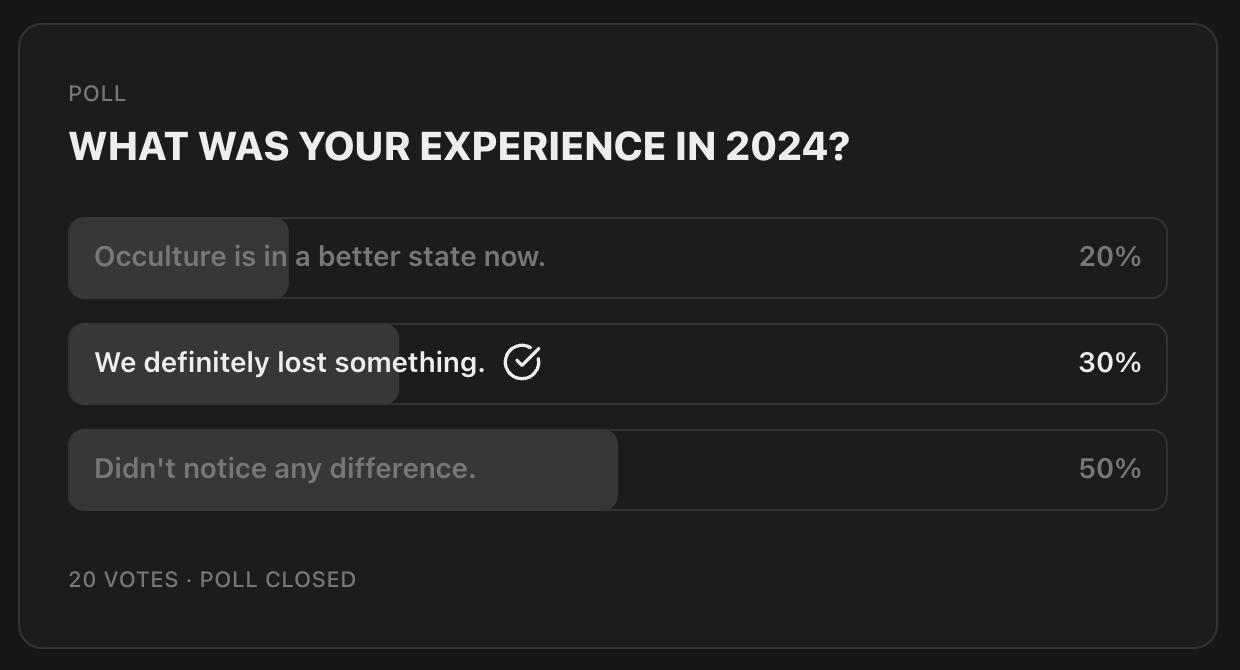
To me, this speaks volumes. It suggests an audience that has become so detached from the online community that even the more dramatic shifts in tone, participation, and quality have flown under their radar. This detachment is both a boon and a curse: on one hand, it indicates that individuals have grown more independent, relying less on the endless scroll of opinions and commentary; on the other, it means that engagement—the very lifeblood of vibrant, learning-focused communities—has quietly withered.
A Look Back, A Step Forward (Into the Past)
In 2023, it seemed as if everything was coming together. I had found a new, more focused teaching model after dumping the Patreon approach, published a successful book, and watched the numbers march steadily upward. Demand was high, and curiosity was abundant.
Even with all the petty squabbles and online theatrics that pervaded the occult milieu, the energy felt electric: newbies were pouring in, courses sold out, and there was a general feeling that the Great Work might actually be thriving on all fronts.
THE EDGELORDS OF THELEMA

One of the most enduring—and undeniably irritating—challenges facing Thelema today is the sheer arrogance and condescension often displayed by its public personas and self-appointed gatekeepers.
And yet, even then, I began noticing the subtle signs. The tides were turning. The frantic velocity with which people had flocked to “find the others” online was decelerating. The glitzy explosion of occulture, which had boomed in the late 2010s and surged again during the pandemic, was inevitably cresting.
Fast forward a year: the exuberant mainstream interest that once fuelled demand has receded, pulling back like an ocean wave, leaving behind mostly driftwood and a few scuttling crabs. Those high numbers, the broad audiences, the casual tourists of esoterica—poof. Gone. And ironically, I’m not even angry about it. Somewhat disgruntled, sure, but I always knew that the frothy hype was unsustainable.
Why Did This Happen?
If you’ve been reading my analyses for the last year, you know I predicted it. The raw truth is that our community—and let’s call it that even if we lack a better term—has been returning to something akin to its old patterns. Those of us who’ve been around the block more than once have seen this before: a boom is always followed by a backslide to the mean, a reassertion of established dynamics.
On one end, you have the ultra-conservative camps of Thelema and occulture, entrenched in their rigid worldviews and desperate to maintain ideological purity. Many of these people never really engaged with the influx of newcomers; they hoped and prayed for the “kids” to leave, taking their memes and shallow engagement with them. On the other end, you have the more liberal or progressive factions who flooded social media with digestible content, trying to popularise esoteric ideas with a single tweet or a quirky TikTok. They harnessed the online wave for a while, but shallow content is hardly the foundation for sustained, deep engagement.
THE STATE OF THELEMA IN 2024

In 2024, we find ourselves witnessing a curious, though not unexpected, return to the status quo within Thelemic circles. After a brief surge in interest during the late 2010s, amplified further by the lockdown years when many found themselves with unexpected free time and a yearning for meaning, the buzz around Thelema has quieted down.
Somewhere between these two extremes lie the real seekers, who are thankfully bypassing the old guard and forging their own paths. But these seekers aren’t flocking to group courses or signing up for year-long training modules the way they used to. They are reading on their own, experimenting privately, keeping their personal occult explorations more guarded and less performative. This is excellent news for the depth of their personal practice—but less than ideal for an educator who relied on a broader audience of curious, if somewhat casual, learners.
The Death of the “Find the Others” Mindset
The old rallying cry of the online esoteric community, borrowed from Timothy Leary—“Find the others!”—has become hollowed out.
Initially, it meant connecting with like-minded souls after discovering who you truly are. Now, it’s a commercial slogan, a tagline for Telegram groups, Discord servers, and digital “covens” that offer prepackaged belonging. The problem is that belonging was never the goal; it was a byproduct of individuals who had already done their inner work. By 2024, more and more people realised that no amount of community membership or virtual ritual circles could replace the slow, painstaking process of self-discovery.
All the while, the toxicity and bad actors infesting these online arenas have made it increasingly unappealing to continue investing in virtual spaces. I regret having waded into too much of the drama on old Twitter, Reddit, or Facebook before finally waking up and disconnecting from it all. If I could rewind, I’d act my age much sooner—no real excuses.
The unsettling fact is that many of these bad actors are driven by political or financial motivations, as became evident during the implosion of the UFOTwitter community a few months ago. With the world growing more dangerous and volatile by the day, this dynamic is genuinely worrying. So people turned inward. They stopped joining and started working alone.
For someone in my position—teaching courses, mentoring students—this is a double-edged sword. I applaud the sentiment. I’ve always believed that authentic magick and deep spiritual growth happen when you step away from the noise, roll up your sleeves, and do the Work. At the same time, I cannot deny that the “online teaching industry” depends on a certain threshold of participation. As the community fragments and individuals move away from commodified community experiences, the wide funnel that once poured eager learners my way has narrowed considerably.
The Academic Influx & The Return of Gatekeeping
Another trend I had anticipated was the creeping return of academia’s gatekeeping role in esoteric study. With the scene contracting and people growing weary of online free-for-alls, there’s an increasing reliance on academically approved materials and credentialed experts. There’s value in this: academic rigor provides quality control, ensuring that seekers rely on thoroughly sourced information rather than the dubious claims of self-styled gurus.
To be clear, I celebrate the much-deserved success of academics such as Dr. Justin Sledge and Dr. Angela Puca, along with the scholars at RENSEP, who tirelessly strive to reconcile the seemingly incompatible worlds of academia and the rest of us mortals. Their work serves as a beacon, illuminating the path forward while showing that intellectual depth can coexist with genuine spiritual inquiry.
But this trend also has a downside. By emphasising academic credentials, we risk sidelining personal gnosis, creativity, and experiential learning. Those of us who spent years championing a more hands-on, exploratory approach to occult study might find the landscape shifting under our feet. Without easy entry points and democratic discourse spaces, newcomers may assume they need a stack of scholarly books and a university library card to get started.
As a result, fewer people join online classes or courses that hinge on a mix of experiential and theoretical learning. Instead, the focus is seemingly back only towards well-researched (and “acceptable”) academic texts, leaving educators to wonder: Is there still room for the teacher who dares to say, “Yes, that’s what the texts say, but here’s how you actually do it”?
Being Honest About Loss
Every entrepreneurial advice column I've ever read would tell me that this is the time to act as though everything is perfect, that I've smoothly transitioned into something new and made a fortune overnight.
Well, I haven’t. The truth is, as the online occult scene has begun to resemble the old-school patterns of smaller, more insular groups, I’ve lost customers. The once steady trickle of new students dried up as people realised that paying for courses wouldn’t magically transmit wisdom. They woke up to the fact that it takes time, daily practice, personal struggle—and none of these come in a neat, commodified package.
So here I am, forced to reckon with a scaled-back version of my audience. It’s not the glamorous outcome you see highlighted on social media. No one is going to retweet this part. But as we move toward 2025, I believe it’s more important than ever to speak candidly, to share that the shifts I predicted had very real consequences—not just for the “scene” but for those of us who, for better or worse, staked a livelihood in it.
This downturn has led me to reconsider how I present my work to the world. While my first book did well enough to justify traditional publishing’s compromises, it didn’t reach the ongoing, stable audience I hoped for.
So, alongside my continued involvement with established publishers—I have a second book, Aleister Crowley’s Mysticism: A Practical Guide, slated for release by Watkins in late 2025—I’ve decided to forge a more independent path. That’s why I founded Chnoubis Imprint, my own publishing platform. This isn’t just a lofty idea; it’s a strategic pivot, one rooted in both practicality and creativity.
Introducing: Chnoubis Imprint
I’ll experiment by releasing “New Aeon Editions” of public domain classics, starting with Bram Stoker’s Dracula. With the cultural spotlight soon to shift back onto this timeless vampire story—thanks in part to Robert Eggers’s upcoming Nosferatu remake—I’m curious to see if I can harness mainstream attention while offering readers a richer, more thoughtfully curated edition. The book will feature custom artwork by Giorgio Anselmi and my own essay, The Saturnian Allure of the Vampire, which explores the occult undercurrents in vampire lore, connecting them to the visions of Albin Grau and Kenneth Grant.


At the same time, I’ll remain engaged with traditional publishing for specific projects, striking a balance between established channels and entrepreneurial avenues. As I navigate these two parallel tracks, I’ll be transparent about the results, sharing not only which strategies work but also the setbacks and insights that come with reinventing my publishing approach. This duality—traditional and independent—feels like a necessary evolution for both my work and my future, and I’ll keep you informed every step of the way.
Looking to 2025: The Future of the Work
If there’s one silver lining, it’s that the people who remain are serious.
The era of shallow engagement, of large but superficial communities, is ending. The seekers who persist are willing to do the Work without shortcuts. They’re not easily swayed by marketing or viral trends; they’re reading carefully, practicing diligently, and forging their own paths. This could lead to a more meaningful exchange with fewer, more dedicated students. Perhaps my role will shift from “broad educator” to “selective mentor,” guiding a smaller cohort of truly committed individuals.
In that spirit, I’ve found renewed inspiration in the in-person setting—such as the insightful retreat I hosted in France this past September, and I’m very much looking forward to the upcoming immersive experience with
in Joshua Tree in just a few months, where direct interaction and shared presence can foster a depth that online spaces rarely achieve. There are still a few spots available, if you too want to be part of what will be remembered as the new “Babalon Working” - yeah, no pressure at all on our shoulders!SOLVITUR AMBULANDO: THE PILGRIMAGE TO OCCITANIA

Most people consider Thelema an expression of ceremonial magic.
At the same time, the tightening of academic control and the quiet fragmentation of the community signal that innovation and experimentation won’t be as visible or accessible. This might be a necessary corrective; after years of chaotic expansion and questionable sources of information, a period of consolidation might help refine the quality of what’s on offer.
Keeping It Real Matters
In a field obsessed with mystique and appearances, it’s almost heretical to admit that I’ve lost ground—and that I even saw it coming. But I’ve always believed honesty to be the cornerstone of any real spiritual work. If I can’t tell you that my business took a hit because the trends I predicted came true, what value do my words carry?
As we stand on the brink of 2025, the occult scene feels quieter, more pensive, and more fragmented. The dynamism of recent years may never return in the same form. But authenticity never goes out of style.
I choose to own my losses and celebrate the new contours of our ever-morphing landscape. If nothing else, at least we know what we’re dealing with—and that clarity, if not comforting, is genuinely valuable.
Dear Marco, thankyou for your truthful observations. I concur. 18 months ago the financial 'wave' started reversing. People, including myself had experienced the 'online course burn'- delivered by 'self appointed gurus', also the face slap reminder that magic in all forms takes enormous self discipline and dedicated time. Of which many don't have. The rowan wand has been replaced by the phone- and conjunctions and manifestations delivered are often not the promised expectation! The 'youngies' have unfortunately witnessed a 'pissing competition' from some sectors of the 'self appointed gurus'- this of course is greatly off putting and aids in the tightening of the purse strings. I like your new direction- it will offer you challenge no doubt but will continue a slower expansion of your readers/students. You've tilled the soil. Fertilized it- and now it's the 'winter of rest'. Thankyou for the work you offer and your writing. Ziggy, New Zealand. The Witch at the Bottom of the World!
Good luck with your new project. The crash you are seeing in industry wide overall (tarot and the like) - I do hope with the “kids going away with their memes” leaves room for meaningful content to be created.